Patient Journey · Columbus, GA
It helps to know what the process actually involves before you start. Here's a realistic picture of how Columbus patients typically move from first noticing knee pain to getting back to normal activity.
Patient Experience
The person in this video was treated for chronic patellar tendinitis — the same condition many Columbus patients arrive with.
TenJet Patient Testimonial - Chronic Patellar Tendinitis (Jumper's Knee)
Video courtesy of HydroCision, Inc., the maker of TenJet®. Individual results vary; this patient's experience is not a guarantee of outcome. Talk with a specialist about whether the procedure is appropriate for you.
Our Network
The Procedure
For patients whose knee pain persists despite rest and physical therapy, Dr. Abdullah may discuss TenJet — a HydroCision, Inc. device that treats the degenerated tendon tissue directly, in-office, without the recovery burden of open surgery.
What Care Looks Like
This is a general pattern, not a guarantee — your own path depends on your specific diagnosis and how your tendon responds to treatment.
A typical journey starts with persistent pain below the kneecap that doesn't resolve with rest. After an evaluation confirms patellar tendinopathy rather than a joint-based cause, most patients begin with a period of activity modification and targeted strengthening. If symptoms persist, an in-office ultrasound-guided procedure is often considered as a next step before surgery is ever discussed — followed by a structured return to activity over several weeks.
Get Started
Call the practice most convenient to you below to ask whether TenJet or another treatment approach is right for your case.
See The Procedure
Official demonstration video from HydroCision, the maker of TenJet, plus a look at how tendinitis differs from the deeper tissue degeneration TenJet is designed to treat.
TenJet Patella Tendinosis Minimally Invasive Tenotomy


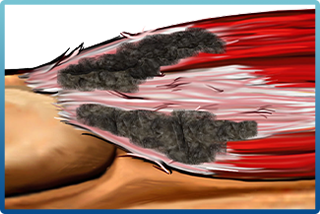
Diagrams and video courtesy of HydroCision, Inc.
Common Questions
Yes, locally in Columbus, Georgia, so patients do not need to travel to metro Atlanta for evaluation or for the procedure.
Continuous ultrasound guidance shows the needle position relative to the tendon and surrounding structures throughout, which is central to how the procedure is performed.
Progressive range of motion and strengthening, typically beginning after the early follow-up visit and building over several weeks under supervision.
Not necessarily. Anterior knee pain has several possible sources, and this procedure is directed specifically at tendon degeneration confirmed on imaging.
This information is general and is not medical advice. Whether any procedure is appropriate for you can only be determined by a physician who has examined you and reviewed your imaging.